
Key Takeaways
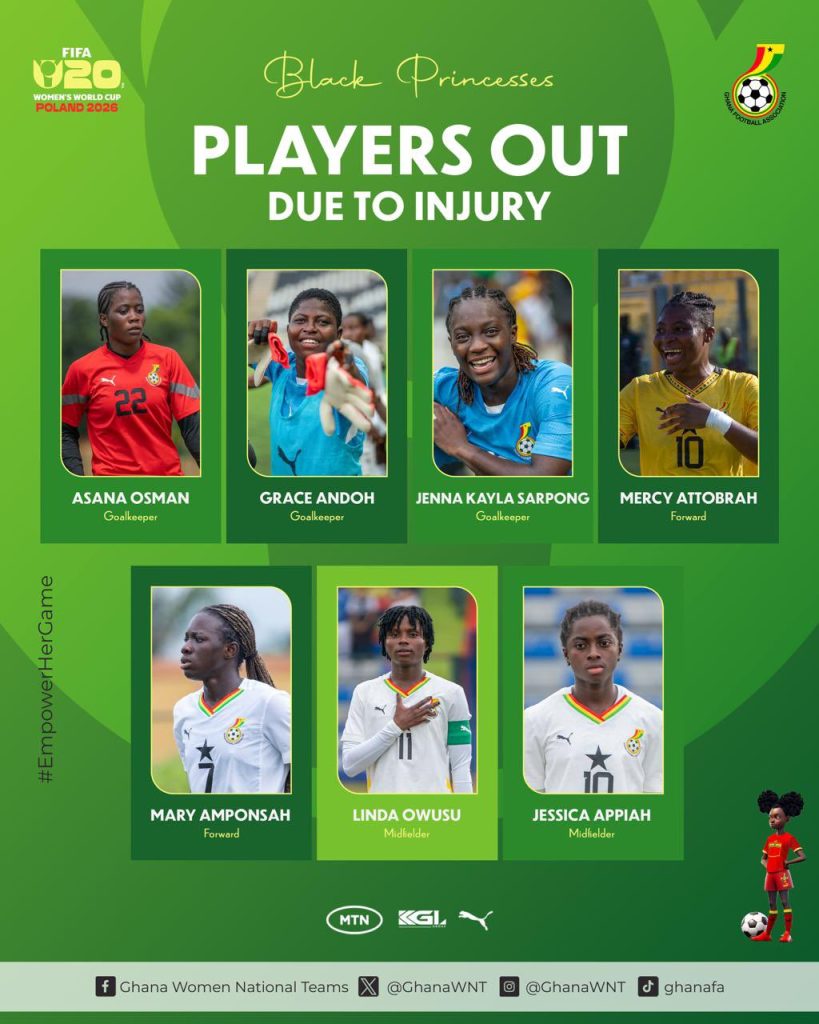
- Seven players, including captain Linda Owusu Ansah, are ruled out through injury.
- Goalkeeping depth reduced to a single fit option.
- Group C opponents Ecuador, South Korea and France present a steep competitive hurdle.
- Coach Yaw Sampson must overhaul defensive and attacking structures before the tournament.
Ghana’s Under‑20 women’s side, the Black Princesses, arrive in Krakow with a depleted roster. An ACL tear suffered by captain Linda Owusu Ansah during the senior Women’s Africa Cup of Nations has removed a key defensive leader from the squad.
Additional setbacks affect the back line, the goalkeeping trio and the forward line, leaving coach Yaw Sampson to reconstruct his game plan ahead of the opening match against Ecuador on 6 September.
Injury Overview
The medical reports list seven confirmed absences: defender Linda Owusu Ansah, goalkeepers Asana Osman, Grace Andoh and Jenna Kayla Sarpong, forwards Mercy Attobrah and Mary Amponsah, and midfielder Jessica Appiah. The injuries span ligament damage, muscular strains and undisclosed ailments, illustrating a breadth of impact across all positions.
Owusu Ansah’s anterior cruciate ligament rupture occurred while she represented the senior Black Queens at the recent Women’s Africa Cup of Nations. Her decisive free‑kick against Uganda during the qualification campaign underscored her importance both as a leader and a set‑piece specialist.
Impact on Squad Dynamics
With the captain sidelined, the defensive hierarchy loses its on‑field anchor. The remaining defenders must assume greater responsibility for organization, while the midfield loses a transitional link in Jessica Appiah.
Goalkeeping depth has been reduced to a single fit player, compelling the coaching staff to consider emergency options or rapid promotion of reserve keepers. In attack, the loss of Attobrah and Amponsah narrows the creative outlet and reduces goal‑scoring diversity.
Strategic Adjustments
Coach Sampson is expected to shift to a more compact formation, possibly a 4‑3‑3 or 3‑5‑2, to compensate for defensive gaps and to protect the limited goalkeeping resources. Emphasis on set‑piece efficiency may rise, given the absence of a primary free‑kick taker.
Young talents from the domestic league are likely to receive accelerated integration, offering the team fresh energy but also exposing inexperience at the world‑stage level. Tactical flexibility will become essential as the squad confronts varied styles from Ecuador’s physicality, South Korea’s speed, and France’s technical prowess.
Looking Ahead
Ghana’s eighth consecutive appearance at the U‑20 Women’s World Cup now hinges on depth, adaptability and the capacity of emerging players to fill the void left by seasoned veterans. The group‑stage schedule leaves little margin for error, making every tactical decision critical.
Should the Black Princesses manage to coalesce around a revised system, they could still challenge for a knockout berth despite the adversity. The tournament will also serve as a benchmark for the nation’s development pathways in women’s football, highlighting the need for robust injury prevention and squad rotation mechanisms."



0 Comments
Leave a Comment
No comments yet. Be the first to share your thoughts!