
Key Takeaways
- President Mahama thanked Ahafo chiefs for their support in the 2024 election.
- The NDC secured five of six parliamentary seats in the Ahafo Region.
- Road projects in Ahafo are slated for inclusion in the second phase of the Big Push Infrastructure Development Programme.
- Government is considering reforms to give traditional authorities a larger role in decentralised governance.
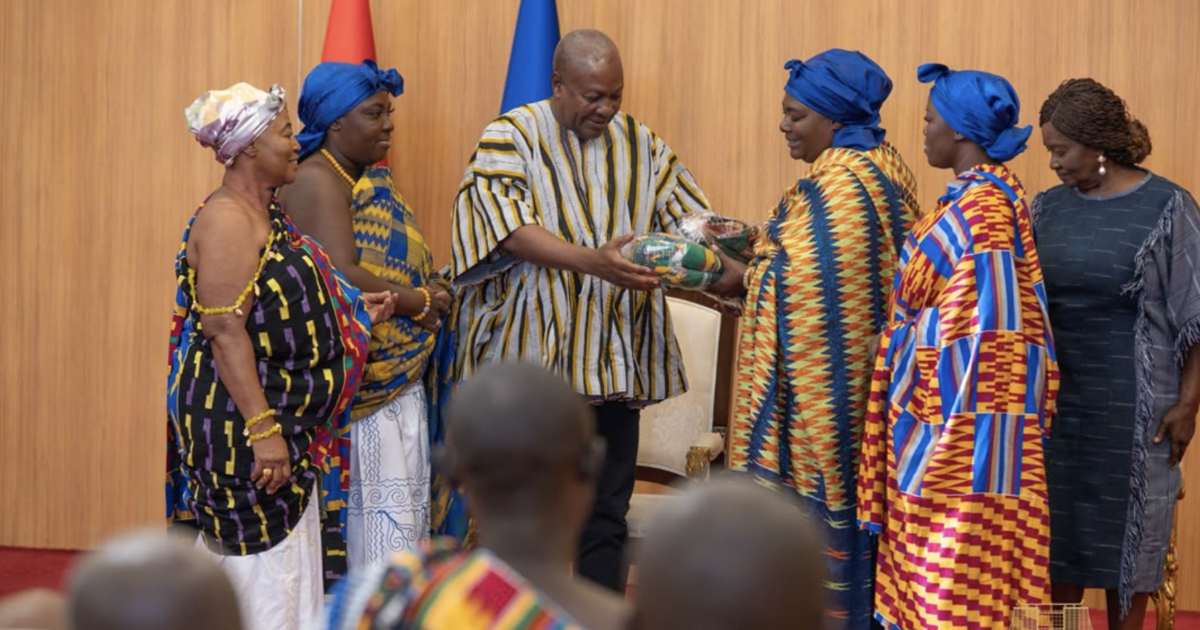
President John Dramani Mahama received a courtesy delegation from the Ahafo Regional House of Chiefs at the Presidency in Accra. The meeting provided a platform for the president to acknowledge the chiefs’ endorsement during the 2024 general election and to outline forthcoming development priorities.
The delegation, led by Nana Barima Twereku Ampem III, Omanhene of the Ntotroso Traditional Area, conveyed congratulations on the electoral outcome and highlighted recent infrastructure projects that have begun to reshape the region’s landscape.
Background & Context
The Ahafo Region, carved out in 2018 as part of Ghana’s effort to create six new administrative regions, remains in the early stages of institutional development. Limited public facilities and nascent administrative structures have historically constrained service delivery. Traditional authorities continue to wield significant social influence, often acting as intermediaries between the state and local communities.
During the 2024 campaign, Mahama visited multiple chiefdom palaces, receiving warm receptions that translated into a strong electoral showing for the National Democratic Congress. The party’s dominance—winning five of six parliamentary seats—reflected both the political mobilisation of the chiefs and the electorate’s desire for accelerated development.
Development Initiatives
The president confirmed that several Ahafo road corridors have been earmarked for the Big Push Infrastructure Development Programme, Ghana’s flagship effort to close the infrastructure gap in newly created regions. Phase two of the programme will extend paving, bridge construction, and drainage works, aiming to connect rural markets with major highways.
Mahama also referenced the Accra‑Kumasi Expressway, a project that promises to reduce travel time between the capital and the central belt, thereby facilitating trade flows for Ahafo’s agricultural producers. The expressway’s completion is expected to stimulate private investment and improve access to health and education services.
In parallel, the administration is reviewing decentralisation reforms that could grant chiefs formal roles in local governance councils, a move intended to harness indigenous knowledge for planning and implementation of public works.
Political Landscape
The electoral success in Ahafo reinforces the NDC’s strategic foothold in Ghana’s central zone, a region historically contested between the two major parties. By aligning development promises with the endorsement of traditional leaders, the government seeks to solidify its political base ahead of the next electoral cycle.
Opposition analysts caution that the delivery timeline for infrastructure projects will be a critical test of the administration’s credibility. Delays could erode the goodwill generated by the chiefs’ support and shift voter sentiment in marginal constituencies.
Economic indicators cited by the president—stabilising macroeconomic conditions and a pivot toward job creation—are intended to complement the infrastructure agenda, signalling a broader growth strategy that targets youth unemployment.
Looking Ahead
Implementation of the road projects and the proposed decentralisation reforms will likely shape the region’s development trajectory over the next five years. Effective coordination between the Ministry of Roads and Highways, regional authorities, and traditional councils will be essential to translate policy into tangible outcomes.
Monitoring mechanisms and community feedback channels are expected to play a larger role as the government seeks to demonstrate accountability and sustain the political alliance forged during the 2024 election.



0 Comments
Leave a Comment
No comments yet. Be the first to share your thoughts!