
Key Takeaways
- Police in the Bono region seized 147 slabs of suspected Indian hemp and over 600 units of Tramadol in a coordinated raid.
- 66‑year‑old Mary Awuni and her 29‑year‑old son Maxwell Akukah were detained and remain in custody.
- Authorities recovered GH¢87,751, CFA 2,000 and 14 blisters of Rohypnol, suggesting a cross‑border trafficking link.
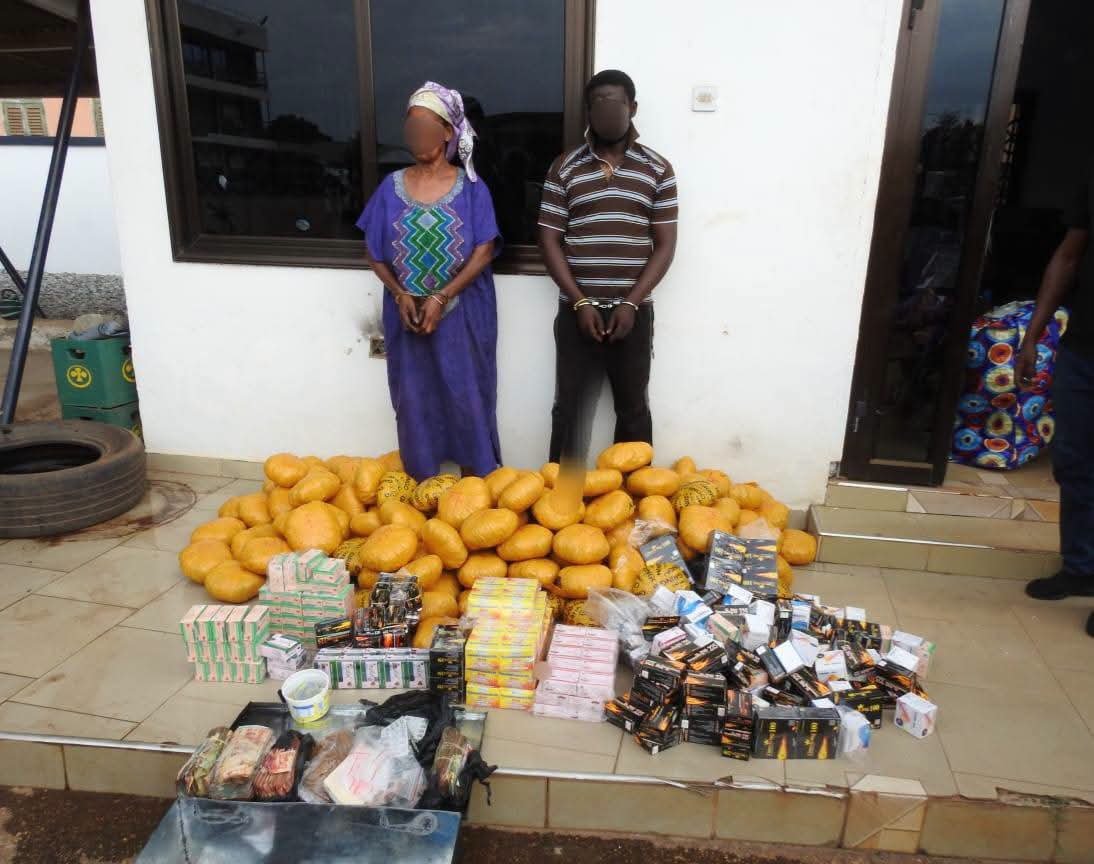
The Bono Regional Drug Law Enforcement Unit conducted an intelligence‑led operation on Kumi Daa Street in Dormaa Ahenkro, uncovering a substantial stockpile of controlled substances. The raid resulted in the arrest of Mary Awuni, 66, and her son Maxwell Akukah, 29, after investigators searched their separate rooms.
Seized items included 147 yellow compressed slabs wrapped in sellotape, identified as Indian hemp, alongside 270 boxes and 329 blisters of assorted Tramadol, 14 blisters of Rohypnol, and cash amounting to GH¢87,751 and CFA 2,000. The police indicated that the haul points to an organized network supplying narcotics across Ghana’s borders.
Operation Overview
The investigation stemmed from tip‑offs that prompted a targeted sweep of the two residences. Officers uncovered a metal trunk in Awuni’s room containing Rohypnol and a sizable sum of money, which the suspect claimed originated from a contact in Accra for delivery to a recipient in Côte d’Ivoire. The son’s quarters yielded additional hemp, Tramadol and cash, which he attributed to his brother Anthony, allegedly absent from Dormaa Ahenkro.
Authorities emphasized that the operation was part of a broader strategy to dismantle drug trafficking routes that exploit the Bono region’s proximity to neighboring countries. The seized quantities exceed typical personal‑use thresholds, indicating intent for distribution.
Context of Narcotics Trafficking in Ghana
Ghana has experienced a surge in the availability of synthetic opioids such as Tramadol and illicit cannabis varieties, often referred to locally as Indian hemp. The commodity’s profitability has attracted transnational networks that leverage informal cross‑border corridors, particularly through the western corridor linking Ghana with Côte d’Ivoire.
Law enforcement agencies have reported an uptick in seizures of compressed cannabis slabs, a form that facilitates concealment and bulk transport. Concurrently, the misuse of prescription‑only tranquilizers like Rohypnol underscores the diversification of drug markets beyond traditional substances.
Implications for Community Safety
The discovery of large cash reserves alongside the narcotics suggests that the operation financed further procurement and distribution activities. Community leaders have expressed concern that such networks can exacerbate public health challenges, including addiction and related crime.
Police have called on residents to provide credible intelligence, reinforcing a collaborative approach to curbing drug‑related offenses. The ongoing investigation aims to trace the supply chain back to the alleged Accra contact and the intended recipient in Côte d’Ivoire.
Looking Ahead
Both Awuni and Akukah remain in police custody and are assisting investigators. Prosecutors are expected to pursue charges that could carry significant penalties under Ghana’s drug control legislation.
The case highlights the need for sustained interdiction efforts and cross‑border cooperation to dismantle trafficking networks that threaten regional security.



0 Comments
Leave a Comment
No comments yet. Be the first to share your thoughts!