
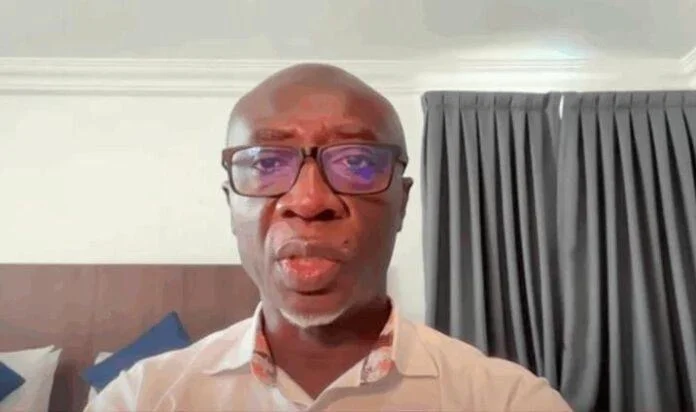
- The Office of the Special Prosecutor (OSP) is not the sole entity responsible for Ghana's challenges in securing the return of former Finance Minister Ken Ofori-Atta.
- Other state institutions, such as the Attorney-General's Office and Ghana's security agencies, should also be considered in assessing the situation.
- The medical circumstances surrounding Mr Ofori-Atta's extended stay in the United States have raised questions about his potential return to Ghana.
The Ghanaian government's efforts to extradite former Finance Minister Ken Ofori-Atta from the United States have hit a roadblock, with a US court raising questions about the evidence presented in Ghana's pursuit of the former minister. Professor Kwadwo Appiagyei Atua, a Professor of International Law at the University of Ghana, has argued that the OSP should not bear sole responsibility for the challenges surrounding Ghana's efforts.
Speaking on JoyNews' Newsfile, Prof Atua emphasized that other state institutions, such as the Attorney-General's Office and Ghana's security agencies, should also be considered in assessing how the matter has developed. He argued that the OSP is being unfairly held responsible for Mr Ofori-Atta's departure from Ghana, citing the former minister's permission to travel for medical reasons as a valid explanation.
The situation surrounding Mr Ofori-Atta's departure from Ghana has been shrouded in controversy, with the OSP maintaining that he remains a fugitive from justice. However, Prof Atua challenged this characterization, pointing out that the former minister had received permission to travel for medical reasons and had subsequently applied for immigration status in the United States.
The medical circumstances surrounding Mr Ofori-Atta's extended stay in the United States have raised questions about his potential return to Ghana. Prof Atua acknowledged that while there are still questions about what is currently preventing his return, the fact that he has applied for immigration status and obtained a green card suggests that he may have a legitimate reason for staying in the United States.
Prof Atua's comments have shed light on the institutional responsibilities surrounding Ghana's efforts to extradite Mr Ofori-Atta. He emphasized that the OSP is not the sole entity responsible for the challenges, and that other state institutions should also be considered in assessing the situation.
The US court's decision to raise questions about the evidence presented in Ghana's pursuit of Mr Ofori-Atta has also been subject to scrutiny. Prof Atua argued that the court may have gone beyond the scope of the matter before it, and that the immigration proceedings were primarily concerned with Mr Ofori-Atta's continued stay in the United States on humanitarian grounds.
The implications of Prof Atua's comments extend beyond the specific case of Mr Ofori-Atta's extradition. They highlight the need for a more nuanced understanding of institutional responsibilities in Ghana's efforts to address corruption and other forms of malfeasance.
In particular, Prof Atua's emphasis on the role of the Attorney-General's Office and Ghana's security agencies suggests that these institutions may have a critical role to play in facilitating the return of fugitives, including Mr Ofori-Atta.
The Ghanaian government's efforts to extradite Mr Ofori-Atta will likely continue to face challenges in the coming months. However, Prof Atua's comments offer a valuable perspective on the institutional responsibilities surrounding the situation.
As the government continues to navigate the complex issues surrounding Mr Ofori-Atta's extradition, it will be essential to consider the roles and responsibilities of all relevant institutions, including the Attorney-General's Office and Ghana's security agencies.



0 Comments
Leave a Comment
No comments yet. Be the first to share your thoughts!